
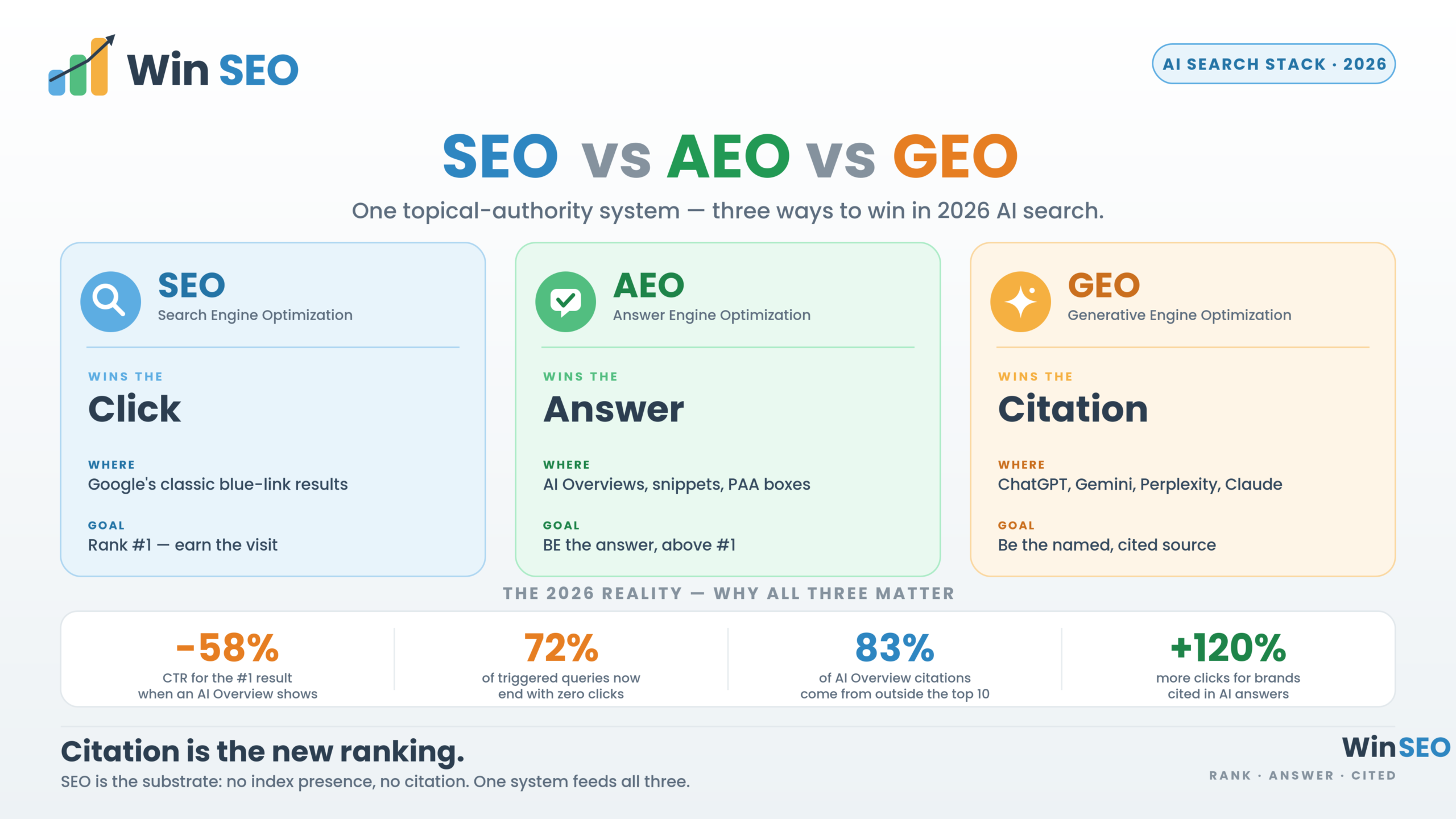
Every few months the industry invents a new acronym and declares the old one dead. Right now you are being told SEO is finished, AEO is the future, GEO is the real future, and you should probably be paying for all three separately. After 22 years of ranking websites through every one of these supposed funerals, here is the truth: SEO, AEO, and GEO are not three strategies. They are three outcomes of one system, and if you build that system properly, you win all three with the same content.
What Is the Difference Between SEO, AEO, and GEO?
SEO (Search Engine Optimization) earns the click in classic ranked results. AEO (Answer Engine Optimization) earns the answer box: featured snippets, People Also Ask, and AI Overviews. GEO (Generative Engine Optimization) earns the citation when AI assistants like ChatGPT, Gemini, Perplexity, and Claude name their sources. Same content, three different surfaces where it can win.
That 60-word answer is the whole taxonomy. The reason it deserves 1,500 more words is that each surface rewards different structural choices, and most websites are built for only the first one.
The 2026 Numbers That Change the Job
None of this would matter if the classic blue links still carried the traffic they used to. They do not, and the numbers tell the story bluntly.
Read those four numbers together and the strategy writes itself. When an AI Overview appears, the famous #1 position loses more than half its clicks. Most answer-triggered queries never produce a click at all. So position alone is no longer the prize. But here is the number that should make you optimistic rather than nervous: 83% of AI Overview citations come from pages outside the top 10. The answer layer is not just skimming the winners of the old game. It is selecting sources by different criteria, which means sites that never cracked page one have a brand-new way in. And being selected pays: brands named in AI answers see roughly 120% more clicks than the position alone would predict. Citation is the new ranking.
SEO Is the Substrate, Not the Casualty
Before you reallocate the budget, understand what did not change. Every answer engine and every generative assistant retrieves from an index, and the pages that get retrieved are overwhelmingly pages that are crawlable, fast, structured, and authoritative. In other words: pages that did their SEO. No index presence, no citation. There is no AEO or GEO for a site Google cannot crawl or has no reason to trust.
So technical SEO, content built for search intent, internal link equity, and topical authority are not the old game. They are the qualifying round for all three games. What changes is what you build on top of that substrate.
AEO: Winning the Answer Box
Answer engines reward content that is structured to be lifted. The mechanics are specific. Lead each section with a direct answer of roughly 40 to 60 words, then expand, because that is the unit snippets and AI Overviews extract. Map your H2s to real questions people ask, not to clever topic labels. Cover People Also Ask questions in a dedicated FAQ block with short, self-contained answers. Mark it up with FAQPage and Article schema so the structure is machine-readable, not just human-readable.
The mindset shift: in SEO you wrote pages. In AEO you write answers that happen to live on pages. A page built this way can sit at position four and still own the answer box above position one.
GEO: Winning the Citation
Generative engines work differently, and the difference matters. When ChatGPT, Gemini, Perplexity, or Claude assemble an answer, they retrieve candidate sources, weigh them, and name a few. Getting named is the new distribution. What earns it, based on what we see across client sites and our own, comes down to four things.
- Entity clarity. The engine must know exactly who you are, what you do, and where. Consistent naming, Organization and LocalBusiness schema, and a coherent footprint across the web. Ambiguous entities do not get cited.
- Quotable structure. Definitions, numbers, and direct claims that can be lifted whole. Generative engines cite sources that make their answer better, not sources that ramble.
- First-hand information. Original data, real experience, specifics no aggregator has. E-E-A-T was always the durable play; generative retrieval just raised its payout.
- Topical depth. Engines associate domains with subjects. A tight cluster that covers a topic completely beats fifty scattered posts, because the engine learns your domain is where that subject lives.
One System Feeds All Three
Look at the two lists above and notice what just happened. Everything that wins AEO and GEO is built from the same materials as modern SEO: intent-matched pages, entity coverage, structured answers, schema, internal links, topical clusters. That is why running three separate strategies, or paying three separate retainers, is the wrong response to the acronym panic.
This is exactly how my AI SEO system is built. One production loop locks the search intent, maps the demand, covers the entities, writes the answer-first draft, formats the snippet blocks, generates the schema, and routes the internal links. The output is a single page that ranks in the blue links, gets lifted into the answer box, and is structured to be cited by generative engines. One system, three surfaces, no triple budget. The case studies show what that looks like with real clients.
What to Change in Your Content This Quarter
If your site was built for classic SEO, you do not need to start over. You need to retrofit. The practical list: add a 40 to 60 word direct answer under your most important H2s. Rewrite headers as questions where the query data supports it. Add FAQPage schema to pages that answer questions and Article schema to posts. Fix your entity signals: one consistent business name, Organization schema, a real about page. Consolidate thin scattered posts into clusters with a pillar. And start tracking AI surfaces: check what ChatGPT and Perplexity say when asked about your category, because that is a ranking report now.
Frequently Asked Questions
Is SEO dead in 2026?
No. SEO is the qualifying layer for everything above it. Answer engines and generative assistants retrieve from search indexes, so crawlability, authority, and intent-matched content decide who is even eligible to be the answer or the citation.
Do I need separate strategies for SEO, AEO, and GEO?
No. You need one topical authority system with answer-first structure, entity clarity, and schema. The three acronyms are three surfaces where the same well-built content wins, not three separate retainers.
How do I get cited in AI Overviews?
Structure content as direct answers under question-mapped headers, add FAQPage and Article schema, and build topical depth. Remember that 83% of AI Overview citations come from outside the top 10, so answer structure can beat raw position.
How do I measure GEO performance?
Ask the engines. Run your money queries through ChatGPT, Perplexity, Gemini, and Claude monthly and log who gets named. Watch referral traffic from AI surfaces in GA4, and track branded search growth, which rises when assistants name you.
What is the difference between AEO and GEO?
AEO targets answer features inside search results: snippets, PAA, AI Overviews. GEO targets generative assistants that compose answers and cite sources. AEO wins the answer box; GEO wins the named citation inside an AI-written response.
Win All Three With One Build
The acronyms will keep coming. The system underneath them has not changed direction in 22 years: understand the intent, cover the topic better than anyone, structure it so machines can read it, and earn the trust signals. If you want to know which of the three surfaces your site is currently losing, the free SEO diagnosis checks all of them and tells you exactly what to fix first.